Free space#
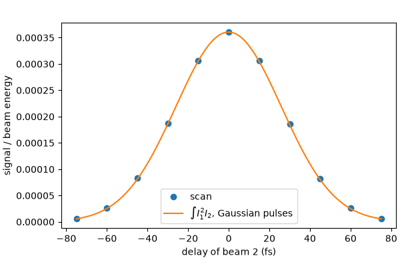
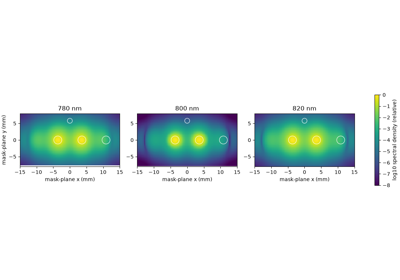
Beams in radial and Cartesian geometries, a self-focusing diagnostic, a line beam uniform in one direction, a planar guide resolved across its width, a weak band calibrated under the low-storage march, a four-wave-mixing delay scan run through one backend with statistics-only planes, far-field spectra collected through apertures in a mask plane, a beam prepared by Kerr self-focusing in a gas gap and coupled into a capillary, a transverse window sized with the boundary monitor, a radial beam and a line beam under the Kerr effect built from plain objects, and two beams crossing in argon, launched together as a sum of beams.
For the full filament and crossing-beam lessons, begin with the Introduction.
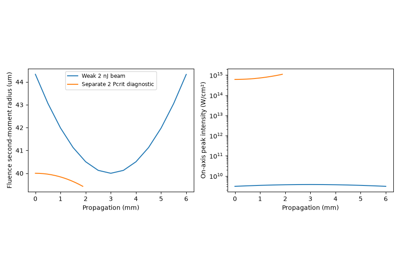
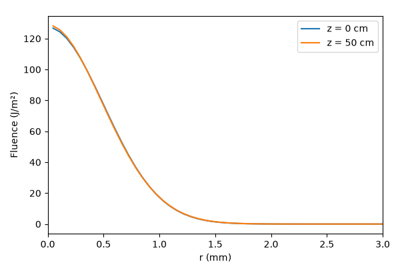
Radial diffraction and a separate self-focusing diagnostic
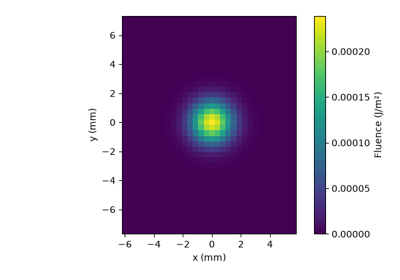
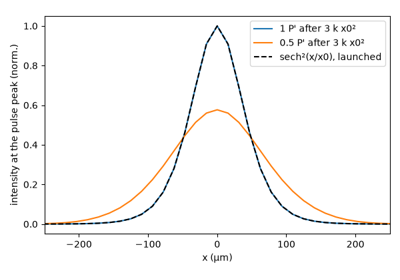
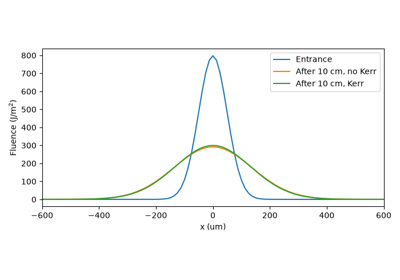
A line beam: diffraction and the (1+1)-D Kerr soliton
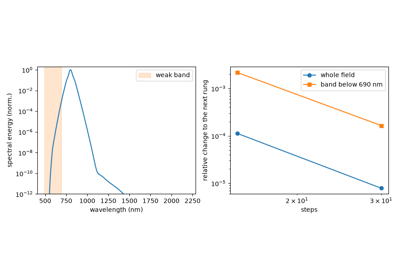
Calibrating a weak band with the low-storage march
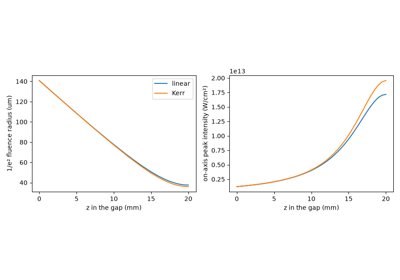
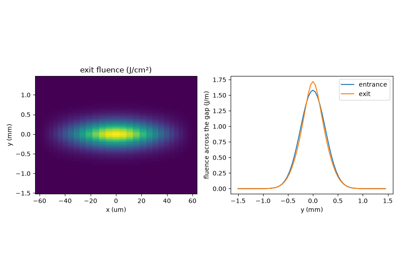
Nonlinear beam preparation and coupling into a capillary